Review
Why this exists
You read your own change before sending it, and that is a different job from reading a diff. Some of what you notice is for you. The rest is for whoever reviews it next, and that half has nowhere to go: you are in a terminal, and your colleagues will read it on a web page you have not opened. So you retype the remark later from memory, or you drop it.
magus already knows the change: which files a target generated, how far each changed symbol reaches, which hunks you have read. Tell it one more thing, where the change is discussed, and you can finish a self-review with the remarks already sent.
What it does
- You see the review's comments beside the code. They render under the hunk they were
written about, in the console and in
magus diff's viewer. - Your own remarks stay drafts until you send them. You write them as you read, then send the set once.
- You answer a thread from the same surface.
magus notes capturekeeps both halves of the conversation as a note in your knowledge graph.
Wire no provider and the diff surface behaves exactly as it did before. Most branches have no pull request open, and that costs you nothing here.
Wiring a provider
magus knows nothing about any forge. It calls four reserved function names on a spell a magusfile selected, and reads what comes back:
import "magus";
import "spells/github/review" as ghReview;

magus\review.provider(ghReview);
| Op | Answers |
|---|---|
find_review |
which review this branch has, and whether it has merged |
review_threads |
the remarks already on it |
publish_review |
send a batch of drafts as one review |
reply_review |
answer one thread |
A spell may implement a subset. A host with no comment API can still take a review body, so a missing op means that provider lacks the capability, not that the spell is broken. See Authoring spells for the shape of a provider op.
GitHub, including GitHub Enterprise
spells/github/review talks to the REST API over plain HTTP with a token; no gh binary is
involved. It reads GITHUB_TOKEN through whatever secret provider the
workspace wired.
The endpoint comes from GITHUB_API_URL and defaults to https://api.github.com, so GitHub
Enterprise Server needs one variable and nothing else:
export GITHUB_API_URL=https://github.example.com/api/v3
magus derives the git remote's host from that endpoint instead of asking you for it separately. Your installation has one host, and a second setting would only give you a way to disagree with the first.
This is a second GitHub spell, beside spells/github/actions, and the runtime is what splits
them rather than the vendor. Every op in that one checks for the Actions runtime token first,
which suits a cache that exists only on a runner. A review happens on your laptop, where that
token never exists, so folding these ops in there would leave them inert. Import both when
you want both.
Reading
In the console's Diff surface:
| Key | Does |
|---|---|
c |
write a remark on the hunk under the cursor |
a |
answer the thread under the cursor |
r |
resolve the comment under the cursor |
s |
read the batch of drafts, then send it |
f |
read one hunk at a time |
Esc |
the changeset overview |
One hunk at a time
A changeset arrives as everything at once: eleven files, a dozen chips, a rail, and somewhere in
it the hunk you were going to judge. f puts one hunk on screen and takes the rest away: the
file index, the counts, all of it one key from coming back.
What replaces them is a line saying where you are: a bar, the position, how many hunks you have read, and how many remarks the pass has produced so far. That last number is the one worth having. It is the evidence that reading is turning into something.
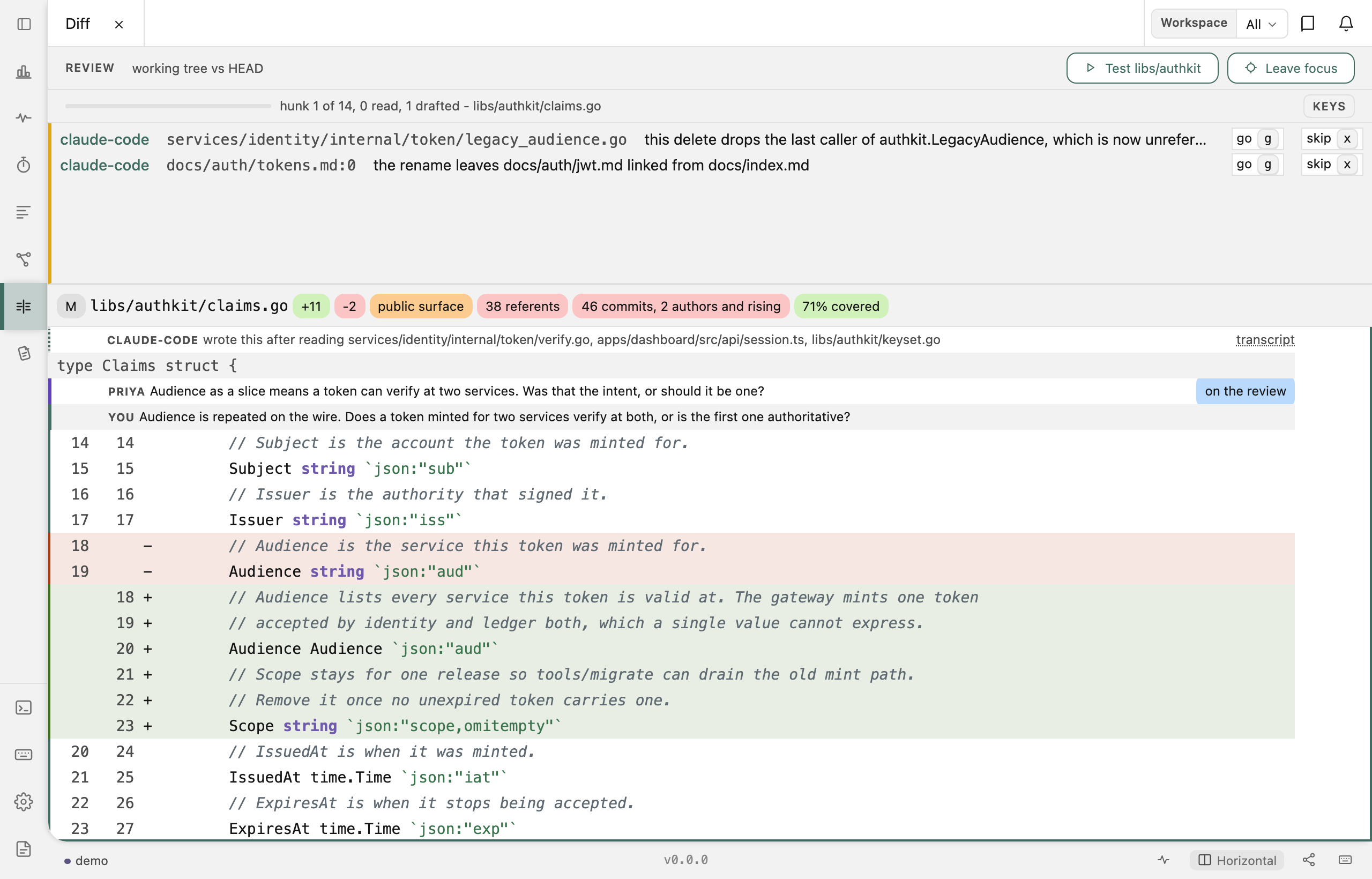
The toolbar collapses with the rest of it: the counts row goes entirely rather than emptying, and the key legend moves onto the progress line, which is the one row a mode about less chrome can still afford.
vmarks this hunk read and moves to the next one. It is one key because it is one act, and a pass that costs two keystrokes a hunk is a pass that gets abandoned halfway.]and[move without marking, for reading something twice.- Reading the last hunk opens the batch you drafted. A pass ends in the decision it was for, rather than running out.
Stop halfway and the marks persist, so opening the diff again puts you back at the first hunk you have not read. The mode is remembered too: it is how you read, not a thing to re-enter every time.
Writing one
A remark is markdown, and the box you write it in is a real one: Enter is a line break, so a paragraph, a list or a fenced block all survive being typed. Committing takes a deliberate act: Cmd or Ctrl with Enter, or the button beside the field, because a field where Enter commits cannot hold a remark worth writing, and because sending is not something to do by reflex.
Write and Preview sit above the field. What a remark looks like rendered is what your colleague will read, and until you can see it here you are typing blind: a fence reads as three backticks, a list as a row of hyphens. Threads render the same way, so a colleague's markdown arrives as markdown rather than as its own syntax.
Remote images are not fetched. A markdown image renders as its alt text, because an image in a remark is a request your browser would make to a host you did not choose.
Sending the batch
s lists the drafts and offers a summary line before anything leaves. You often change your
mind about the first remark by the time you write the fifth, which is why they wait. The
summary is optional; the list of what is about to go is not.
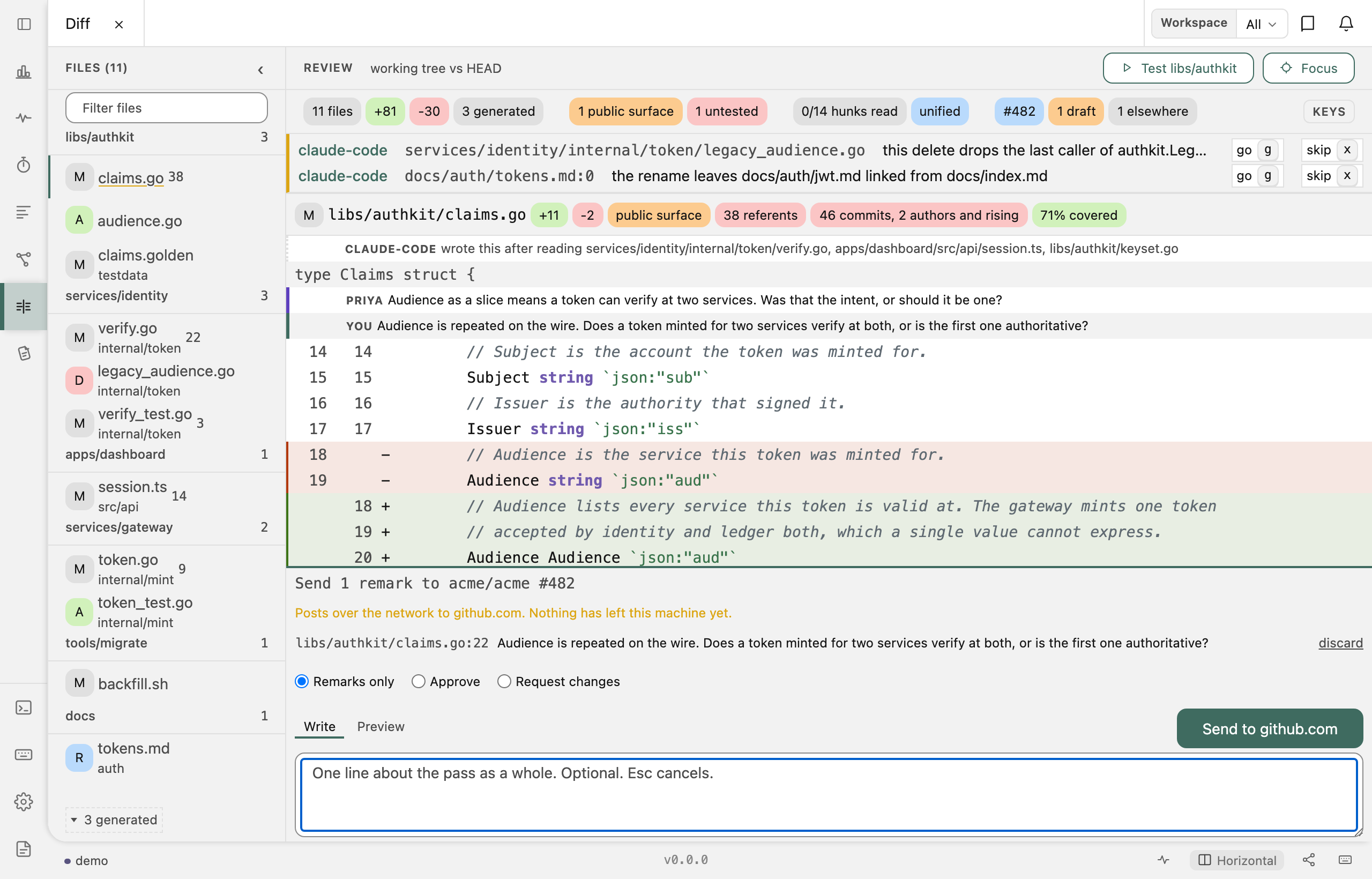
The box names the repository, the review and the host before you commit to any of them, and says plainly that nothing has gone yet. A remark you have changed your mind about is discarded from this list.
magus diff's terminal viewer renders the same threads under the same hunks, re-placed against
the patch it is showing. It cannot publish, and no review command carries a --publish flag:
you send with the batch in front of you or you do not send.
Two things the console has that the terminal viewer does not yet: reading one hunk at a time
(f), and the run control below. Both are read-side and nothing about a terminal prevents them;
they are missing, not withheld, unlike publishing. --prompt needs neither: it is a flag on
magus diff itself, and the viewer stands aside for it the way it does for --impact.
Where a remark lands
A colleague anchors a thread to a line of the review, which is not the changeset in front of you. Your working tree moves after they write, and a pull request covers commits a working diff does not. So each thread lands in one of three places, and the console drops none of them:
- on the hunk holding its line;
- under the file heading, when this changeset no longer contains that line;
- listed as elsewhere (press
Escfor the overview), when the file is not on screen at all: either outside this changeset, or folded away, as a generated file is by default.
The third bucket is keyed on what the surface is showing rather than on what the changeset
holds, because a thread rendered nowhere and a thread on a folded file look identical to the
reader: absent. magus diff's viewer lists the same third bucket at the end of the changeset,
so neither surface drops one.
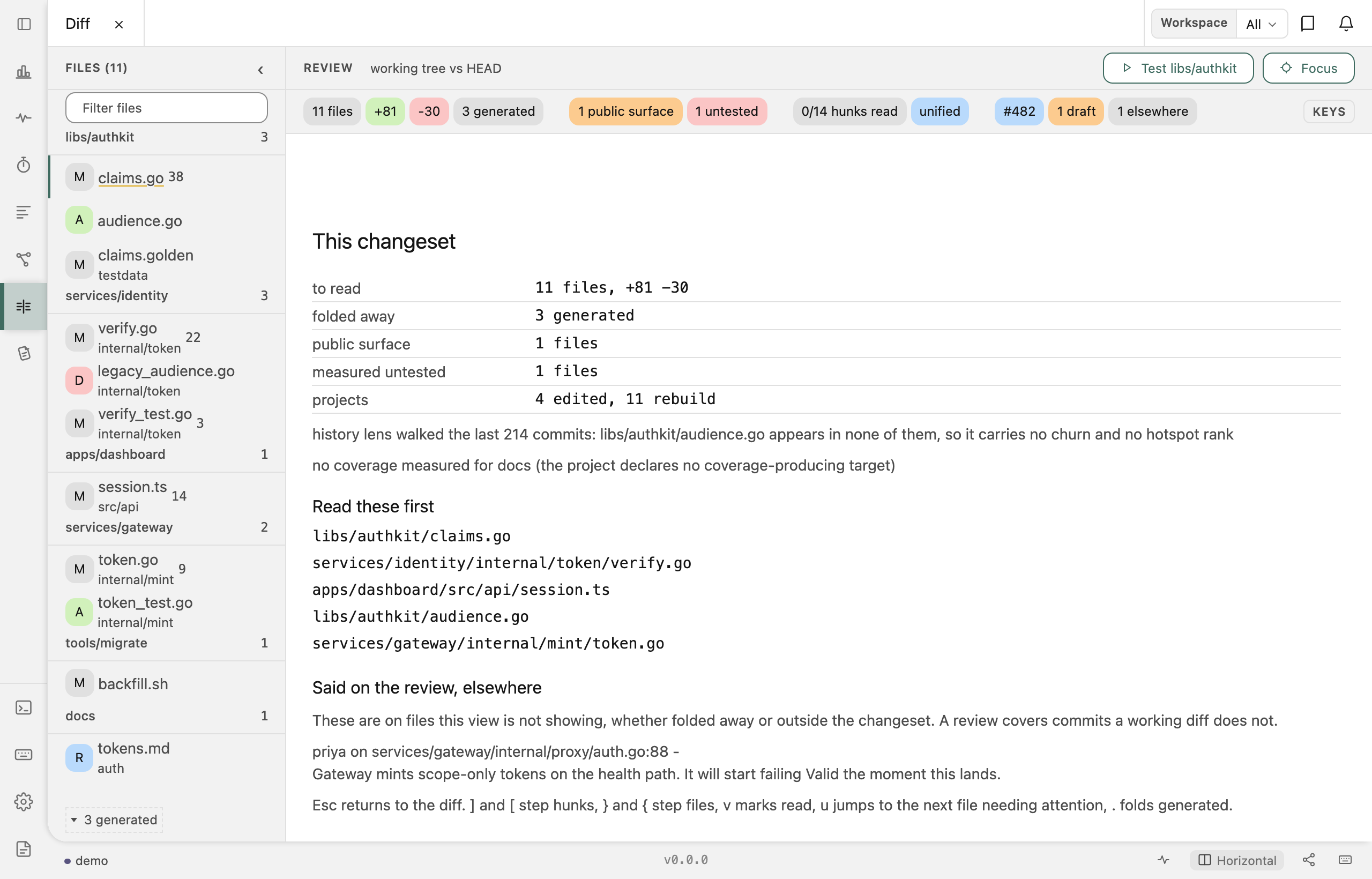
The overview reads those remarks out rather than counting them. A chip saying "1 elsewhere" tells you something was said and withholds what, which leaves you to open a browser to find out, the one errand this whole surface exists to save you.
When somebody says something
A remark arriving on your review is the one thing here that interrupts you. The bell rings, and the reason it earns that is not that something happened; it is that somebody is waiting on you, and a question left sitting for a day costs your colleague their day too.
The threads that arrived since you last read the conversation are marked new where they sit in the diff, so opening it shows you where to look instead of making you re-read.
What counts as new is decided by threads you have actually had on screen, not by a timestamp and not by anything the watcher recorded for itself. That is the same rule as a read mark: it is the reader's claim, and nothing else may make it on your behalf.
Who else is changing this
A file heading says also on 2 branches when other branches are changing the same file. It is a report, not a prediction: two branches touching one file is ordinary and usually fine, and "conflict likely" would be magus guessing at an outcome it cannot see.
Both your own branches and the remote-tracking copies of everyone else's. Local ones matter most where they are least visible: several agents in several worktrees of one repository are all on branches nobody has pushed, and a lookup that read only remote-tracking refs answered nothing there, which reads exactly like nothing competing.
magus never fetches to answer this, so the two kinds are as fresh as different moments and the tooltip says which: a local branch is here now, and a remote-tracking one is true as of your last fetch and no fresher. Nothing here goes to the network on its own.
A branch and its remote-tracking copy are one line of work under two names, so they are reported once, under the local side.
A backend that cannot answer says nothing at all, which is deliberately different from saying nothing competes; those are different facts, and only one of them is reassuring.
After it merges
A merged pull request is where a review stops being live and becomes the only record of why the code is the way it is, and that record is on somebody else's website. So when the host says a review you took part in has landed, magus offers once to keep the conversation:
This review merged on acme/acme, and its 3 remarks live only on the host. Run
magus notes captureto keep the conversation in your knowledge graph.
It arrives two ways, and neither interrupts you. Open the diff on a merged review and it is a strip under the toolbar. Merge while you are elsewhere in the console and it is recorded in the notification panel, silently: a merge changes nothing you were relying on, so it is worth keeping and not worth ringing a bell for.
That second one asks the host on a slow clock and only for a branch you actually reviewed: opening a review is what opts it in. magus does not go asking a forge about branches you never looked at.
Only when there was a conversation. A pull request nobody remarked on has nothing worth preserving, and a prompt that fires on every merge is one you learn to dismiss without reading, which spends the attention it was saving for the merge that mattered.
It names the command rather than running it. Notes are human-authored by construction, which is a standing decision rather than an omission here.
magus asks the provider whether a review merged rather than working it out from git, and that is
not a preference. A squash merge rewrites a branch into one new commit, so the branch tip is
neither an ancestor of the base nor patch-equivalent to what landed; a workspace that
squash-merges would never see its own merges. A provider answers state on find_review, and a
provider that does not answer reads as open.
Does it still pass
The toolbar carries one run control, for the project of the file you are reading. Press it and
magus runs that project's test target here, on the machine the code is on.
This is the one review capability that has no provider behind it, and so no capability gap: it asks the local workspace rather than a host, and behaves identically on GitHub, GitLab, git, hg, or no forge at all. It is also the thing a forge structurally cannot offer, because a forge does not know your build.
Three things keep it honest:
- It runs what the magusfile declares, and nothing else. The console names a target and a project, never a command. The server admits the run only if that project declares that target, so a browser-reachable button is strictly less capable than a terminal.
- A verdict is about a TREE STATE. Edit anything and the answer greys out and says
passed - since edited, because a green tick over code you have since changed is a wrong answer delivered confidently. A cache hit is not stale, though: magus keys the cache on the target's sources, so a replayed verdict is a true statement about the tree it was computed from. - A run already in flight is joined, not duplicated. If your own terminal is running the same target, the control says it is running rather than appearing to have started it.
There is one button, not one per file. The question is asked about one place at a time, and a control on every file heading would answer it n times in a column.
Handing the change to your own model
magus diff --prompt
prints a review prompt to paste into whichever model you use. --prompt --impact adds the
rationale behind each instruction, for a reader deciding whether to trust it.
magus assembles it and stops. Nothing calls a model, holds a key, or sends anything anywhere: the clipboard is the airgap, and it is what keeps the review something you wrote. The prompt asks for findings, and says so out loud: file, line, what is wrong. It does not ask for review prose, because generated text is the wrong thing to put in front of the colleague who asked.
It reads the working tree by default, and a patch file when you hand it one. Against a patch with a single changed file:
$ magus diff --prompt --patch change.patch
# Review this change

Find what is worth commenting on. I will write the actual review comments myself, so
give me findings - file, line, what is wrong - and flag the ones you are unsure of.
Do not draft review prose or a summary I could paste.

## What this is

- compared against: change.patch
- 1 changed file(s)
- projects edited directly: .

## Read in this order

magus ranked these by what they can break, consequence first.

- `main.go` - source; in .

## Conformance

Where these symbols differ from how the rest of the workspace declares the same kind of thing; weigh, do not enforce.

- not checked: `.` (no symbol indexer)

## What magus could not measure

Do not read any of these as evidence that there is nothing there.

- no symbol index loaded: changed-symbol callers and coverage overlays are unavailable (build it with `magus graph build`)

## Use what is already installed

Load these rather than inferring from the diff alone:

- `magus-query` - what references what, without guessing from a text search
- `magus-architecture-review` - where code belongs, grounded in the graph

Follow the conventions this workspace documents over generic ones.
Before reporting a finding, look for the test that PINS the behavior you are about
to call a bug. If you cannot find where a claim is verified, say it is unverified.
What it carries is the part no model can work out from a diff: the reading order magus ranked, which projects rebuild as a result, what could NOT be measured, and which other branches are changing the same files. What it does NOT carry is the durable half of a review briefing: it names the magus skills you already have rather than pasting copies of them, because a copy drifts from the installed one and spends your context on text your tools already loaded.
What magus will not do
- An agent cannot publish. An agent pairing over MCP reads the review's threads and may draft a comment into the shared session. You send it. magus stamps authorship from the transport a write arrived on rather than from the payload, so nothing can claim to be you.
- An agent cannot reply to a person. A remark is addressed to whoever reads the review; a reply is addressed to the colleague who asked, by name. There is no agent-reachable op that produces one; replying lives on the human route alone, so an answer to your colleague is something you wrote. Receiving generated text where you asked a question is how the human half of a review dies, and this is the one place magus spends a refusal to prevent it.
- A review never approves a change its own credential opened. Reviewing a colleague's branch, you may approve or request changes; on your own, the verdict is silently downgraded to remarks and the surface says so. The API would happily let your change approve itself, which is why the rule lives in magus rather than in a spell you could edit, and why "magus could not tell who opened this" resolves the same way as "you did". Not knowing is not permission.
- A draft with no line never moves to a line magus guessed. The send box marks those before you send, because a remark that arrives against the wrong code costs more than one the host refused.
See also
- Authoring spells: the provider-op shape and every contract magus detects by name.
- Secrets: how the token reaches the spell without being written down.
- Knowledge: where a captured review conversation lives afterwards.